Confession and absolution
The SonConfession and absolution in the prison scenes around Sonny Lofthus combine religious ritual with the need to be heard. Inmates approach Sonny for forgiveness and peace of mind, while his silence makes him a compelling listener. The practice is neither merely devotional nor simply a tactic: it offers comfort, opens a channel for secrets, and becomes entangled with the criminal forces operating inside Staten Maximum Security Prison.
Sonny as Confessor
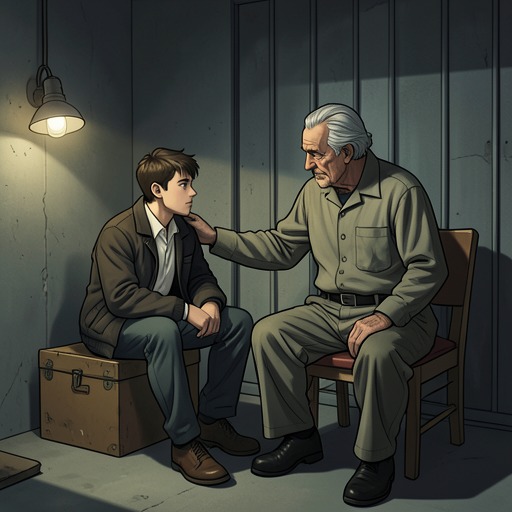
Rover visits Sonny in an eleven-square-metre cell while preparing for release from Staten Maximum Security Prison. He wants his sins forgiven and hopes to leave feeling cleansed, although he admits that he is not religious. What he confesses is grave: Hugo Nestor had instructed him to shoot a young woman known by the nickname Minsk, whom Rover believed came from Belarus. Sonny initially remains silent, his gaze fixed beyond Rover, and Rover’s account therefore unfolds without interrogation or visible judgment.
The silence is itself part of the encounter’s power. A prison chaplain recognizes that inmates go to Sonny because he listens without reacting or condemning them. The chaplain had spent his life trying to develop that ability but believes the inmates sensed that he wanted something from their secrets, including the possibility of drawing them toward religion. Sonny, by contrast, seems to ask for nothing in return. His listening creates a space in which a confession can be spoken without the confessor first having to defend or explain himself.
The Blessing and Its Limits
When Rover asks for a blessing, Sonny signals that he should come closer and kneel on a prayer rug. The rug is conspicuous in a prison where possessions are tightly limited: under the institution’s twenty-item rule, inmates must trade away other belongings to keep additional items. Sonny places a hand on Rover’s shaved head and gives a blessing that invokes mercy and forgiveness while acknowledging that Rover will die. The ritual offers Rover a measure of peace, but the scene does not establish that it changes the consequences of the crime he has confessed.
Rover doubts both the supernatural claims surrounding Sonny and the idea that the young man’s touch can heal. He nevertheless accepts the blessing as a form of reassurance, much as someone might pay for protection against a danger they do not expect to face. This gap between disbelief and participation defines the practice: its immediate value lies less in proof of divine intervention than in the comfort of being heard and absolved. Sonny’s rumored history of killing also leaves Rover unable to reconcile the apparent source of mercy with the possibility of violence.
Listening, Secrets, and Hidden Transactions
The confessional role does not make Sonny’s encounters free of practical purpose. A chaplain discovers that a Bible Sonny has opened contains a hollow compartment holding folded papers with information Sonny needs in order to confess, along with three small bags of heroin. The sacred object thus serves as concealment as well as religious imagery. The episode complicates any simple division between spiritual refuge and prison contraband: Sonny’s apparent willingness to receive sins exists alongside his participation in a covert system of information and drugs.
That entanglement becomes clearer when Sonny speaks with Johannes Halden. Sonny asks whether Halden will do something for him outside the prison, and Halden responds by asking whether Sonny will grant him absolution. Their exchange links a hoped-for act beyond the prison walls to the spiritual assurance Halden seeks. The evidence does not specify the requested outside task here, but the juxtaposition makes clear that absolution can operate within a relationship involving obligation as well as faith.
Absolution Under Prison Power
The prison’s authority also intrudes upon the possibility of confession. Arild Franck invokes the suspected suicide of an inmate associated with Nestor, suggesting that fear and the possibility of access to a cell can make prisoners vulnerable even behind locked doors. The episode places the need for a trusted listener against an institution in which safety can be uncertain and information can carry danger. Sonny’s quiet presence consequently offers a striking contrast to the coercive pressures surrounding him, without removing him from those pressures.
Franck later tries to force Johannes to reveal Sonny’s whereabouts, threatening to end Johannes’s cancer treatment and dismissing doctor–patient confidentiality. Johannes refuses to give up the information, saying that his sins have been forgiven and that he may have a chance of reaching heaven. His response turns the promise of absolution into a source of resolve when worldly protection is being threatened. The scene also shows how forgiveness can matter not as an escape from death, but as a way of facing the prospect of it.
Confession as Motif and Moral Tension
Across these encounters, confession means more than naming wrongdoing. It is a search for release from guilt, but it also exposes the person who speaks to whoever is listening. Sonny’s lack of visible judgment encourages disclosure; the hidden papers in the Bible show that the information surrounding confession can have uses beyond spiritual care. The novel keeps both possibilities in view, making the confessional space intimate without making it secure.
The blessing likewise holds comfort and limitation together. Rover accepts it despite his skepticism, while Johannes draws strength from the belief that his sins have been forgiven when Franck threatens his treatment. Yet neither encounter erases the violence or institutional power that gave confession its urgency. Absolution offers a language for mercy in a prison shaped by secrets, danger, and compromised authority; its force rests in the characters’ need to believe that a person can listen without turning what he hears into judgment or leverage.